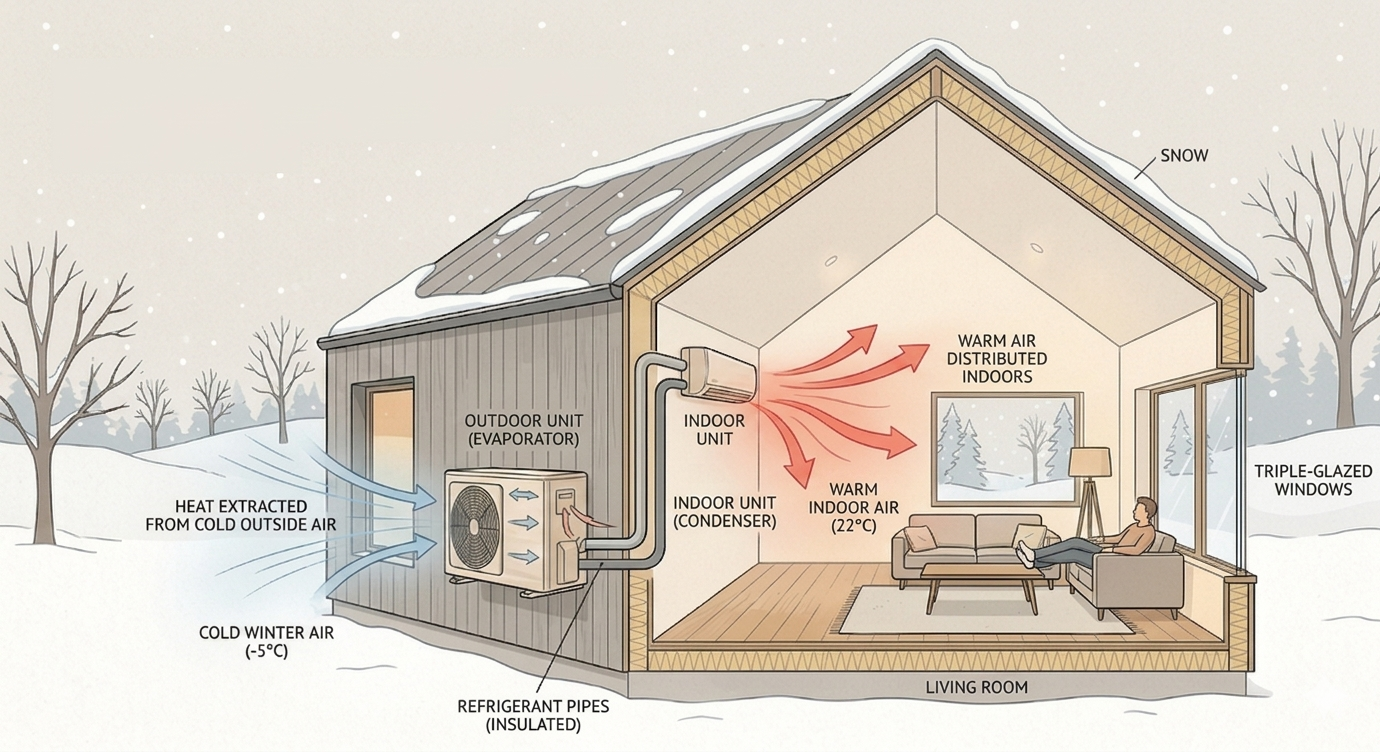
Now, what is a heat pump and how does it work? A heat pump is a device that transfers heat from one space to another, and to do that, it uses mechanical or thermal energy. In most of the cases we will discuss in this post, the mechanical energy is given by a compressor that requires electricity to work. The reason why heat pumps require energy to transfer heat is that, naturally, heat transfer happens from the warmer space to the colder space, and since the usual case is that we want to transfer from a cold (outside in winter) to a warmer space (indoors at home), then external energy input is needed.
The different types of heat pump depend on where they take the heat from and how they distribute it inside the house. Let's have a look at the most common types of heat pump and when to use each of them.
Air-to-air heat pump
This is the most common and usually the most cost-effective heat pump for smaller homes or as a complement to existing heating systems. An air-to-air heat pump extracts heat from the outdoor air and releases it directly into the indoor air via an indoor unit (split). In practice, it works as reverse air conditioning.
It is best suited for:
- Smaller houses or apartments
- Homes with direct electric heating
- Properties where installation simplicity and low upfront cost are important
Key limitations
- It does not produce hot water
- Heat distribution is localized, meaning multiple indoor units may be needed for larger or multi-floor homes
- Efficiency drops at very low outdoor temperatures, although modern systems still perform reasonably well in Nordic climates
In Sweden, this is often used as a "base heater" that reduces electricity consumption significantly, especially in spring or autumn.
Air-to-water heat pump
An air-to-water heat pump transfers heat from the outdoor air into a water-based heating system. That water is then used for radiators, underfloor heating, and domestic hot water.
It is best suited for:
- Houses with waterborne heating systems
- Full system replacements (oil, electric boilers, district heating alternatives)
- Homes with higher and more stable heating demand
Key advantages
- Provides both space heating and hot water
- Can integrate with existing radiator or underfloor systems
- Good balance between installation cost and efficiency
Key limitations
- Higher upfront cost than air-to-air systems
- Slightly lower efficiency in very cold winter periods compared to ground source systems
- Requires a compatible hydronic (water-based) system
This is often the "default upgrade path" in Swedish homes transitioning away from direct electric or fossil-based heating.
Ground source heat pump (deep borehole / bergvarme)
A ground source heat pump extracts heat from deep rock via a borehole, typically 100-200 meters deep. The temperature underground remains relatively stable year-round, which makes this system highly efficient.
It is best suited for:
- Detached houses with high heating demand
- Long-term homeowners willing to invest upfront
- Properties where drilling is possible (rock access required)
Key advantages
- Highest and most stable efficiency (high seasonal performance factor)
- Very low operating costs over time
- Strong performance even in very cold winters
Key limitations
- Very high installation cost due to drilling
- Requires geological suitability (rock conditions)
- Longer payback period, but strong lifetime economics
This is generally considered the premium solution in Sweden when long-term energy cost optimization is the priority.
Ground source heat pump (shallow / surface loop)
In cases where drilling deep into rock is not possible or not economically justified, a shallow ground source system can be used. This is typically done through horizontal ground loops buried at shallow depth (often 0.8-1.5 meters).
It is best suited for:
- Houses with available garden/land area
- New builds or major renovations
- Locations without suitable rock drilling conditions
Key advantages
- Lower installation cost than deep boreholes
- Still benefits from relatively stable ground temperatures
- No need for deep drilling permits or geological uncertainty
Key limitations
- Requires significant land area
- Efficiency can vary more with seasonal soil temperature changes
- Installation is disruptive due to excavation requirements
This solution is often a compromise between air-based systems and full deep geothermal systems.
Exhaust air heat pump (franluftsvarmepump)
When there is a mechanical ventilation system in the house an exhaust air heat pump recovers heat from the ventilation air that is being extracted from the house. Instead of letting warm indoor air go to waste, it captures that energy and upgrades it for reuse.
It is best suited for:
- Modern, well-insulated homes with mechanical ventilation (F-system)
- Smaller to medium-sized houses
- New builds designed for low-energy consumption
Key advantages
- Very compact system (heating + hot water + ventilation in one unit)
- Efficient in tightly sealed modern buildings
- Lower installation complexity in new builds
Key limitations
- Limited capacity for high heating demand homes
- Performance depends heavily on building airtightness and insulation level
- Often insufficient as a standalone solution in older or poorly insulated houses
This system makes most sense when the building is already designed around controlled ventilation and low energy loss.
Summary comparison table
Here is a side-by-side comparison of the main heat pump types to help you understand the trade-offs at a glance.
Air-to-air
Air-to-water
Ground source (deep)
Ground source (shallow)
Exhaust air
| Heat pump type | Cost (installed) | Efficiency (SCOP*) | Best for |
|---|---|---|---|
| Air-to-air | Low (15,000-30,000 SEK) | Medium (3-4) | Apartments, small houses, or as a supplement to electric heating |
| Air-to-water | Medium-High (90,000-180,000 SEK) | Medium-High (3-5) | Houses with waterborne heating (radiators or underfloor heating) |
| Ground source (deep) | High (140,000-250,000+ SEK) | Very high (4-5.5) | Detached houses with high energy demand and access to rock drilling |
| Ground source (shallow) | Medium-High (100,000-200,000 SEK) | High (3.5-4.5) | Properties with large garden area where drilling is not possible |
| Exhaust air | Medium (80,000-150,000 SEK) | Medium (2.5-3.5) | New or energy-efficient homes with mechanical ventilation systems |
*SCOP: Seasonal Coefficient of Performance. It is a ratio that tells you how many units of heat you get for every 1 unit of electricity consumed. For example, an SCOP of 4 means that over a whole year, the system produces 4 units of heat for every 1 unit of electricity it uses.
How to dimension the heat pump you need
Choosing the correct heat pump size is mainly about matching the system to the house's real heating demand. The most important factor is not the floor area alone, but how much heat the house loses during winter. That's why when you fill in our questionnaire in the beginning we ask for location and house details.
For instance, a house in Gothenburg will typically need a smaller heat pump than an identical house in northern Sweden because winters are milder.
Annual energy consumption is also a strong indicator, since it reflects how much heating energy the house actually uses over a year.
The heat pump should usually be sized to cover most of the yearly heating demand, not necessarily the absolute coldest winter peak.
In Sweden, many homes intentionally combine a heat pump with direct electric heating or a fireplace for the coldest days. This often allows a smaller and more cost-effective heat pump to be installed while still achieving high savings.
Oversizing a heat pump can increase installation cost and reduce efficiency during mild weather due to short cycling. A correctly sized system provides the best balance between comfort, energy savings, noise level, and long-term operating cost. For this reason, some of our scenarios propose to improve insulation before adding a heat pump.
Want to find out which heat pump type and size fits your home? Use our tool to analyze your home's energy needs and get a personalized recommendation.